
How Lance Lewman built a creative career by refusing to let great stories disappear
The playwright and performer shares lessons on persistence, iteration, collaboration, and why the best ideas often take decades to reach their full potential.

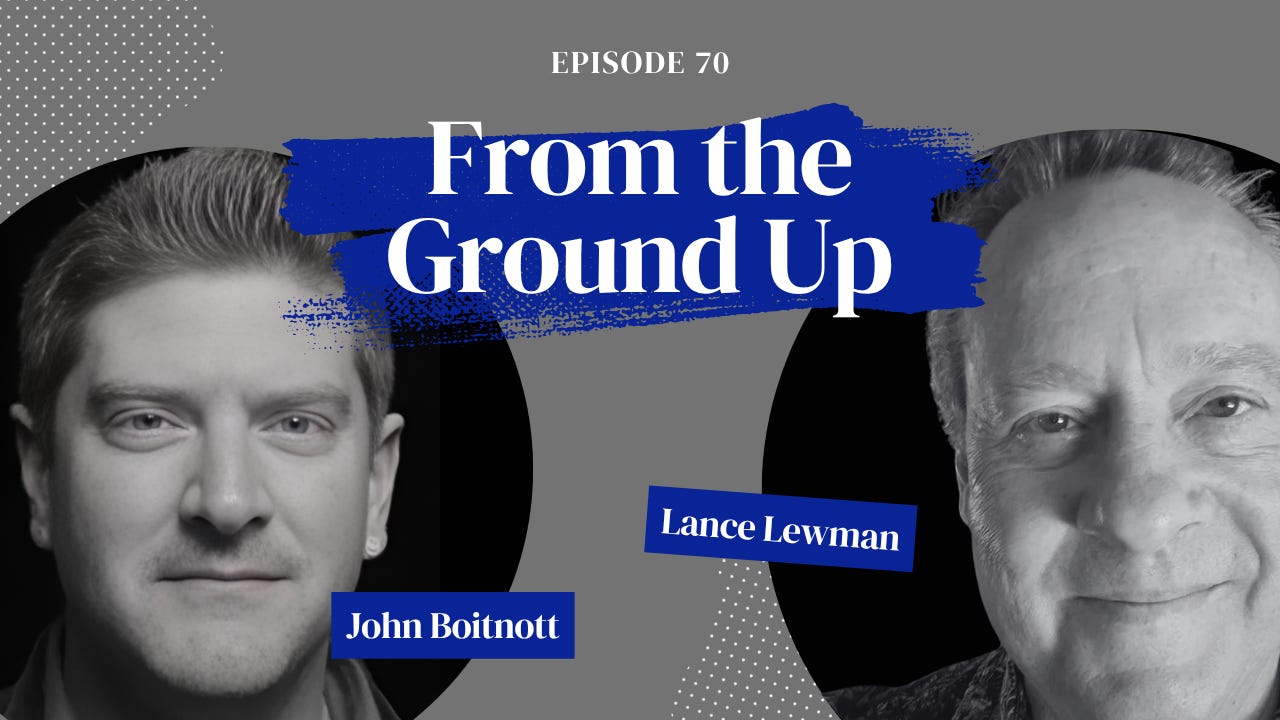
Some stories disappear because they were never important enough to preserve. Others disappear because history decided not to remember them.
Actor, performer, and playwright Lance Lewman has built his creative work around bringing those stories back.
His musical Brilliance examines the life of actress Frances Farmer, whose career and reputation were shaped by forced institutionalization, family conflict, and the limited understanding of mental health in her era. A second musical focuses on Florence Mills, a celebrated Black performer who drew enormous audiences in the 1920s but left behind almost no recordings or film.
For Lewman, theater offers more than entertainment. It can restore complexity to people who have been reduced to myths, diagnoses, or footnotes.
For more of my work, subscribe at 20% off below, and check out my Medium too.
Get 20% off forever
A Musical That Took Decades to Become Real
The first song that eventually became part of Brilliance was written in 1983.
Lewman and his collaborator and wife, Kristen King, had no formal plan to create a full musical. They wrote songs inspired by Farmer’s life and placed them in an envelope labeled “musical.”
The project remained there for more than three decades.
It returned when King recorded one of the songs for an album and a listener remarked that it sounded like the climactic number from a stage production. Lewman took the comment as a challenge and finally wrote the book.
His first version ran nearly four hours.
The long process that followed included readings, major revisions, professional feedback, and the gradual realization that a musical is not written once. It is discovered through performance.
The Danger of Turning People Into Villains
One of the most important changes to Brilliance came through an unexpected personal connection.
While researching Farmer, Lewman contacted an expert who helped connect him with her nephew, David Farmer. Their conversations changed how Lewman understood the family story.
Earlier accounts often portrayed Farmer’s mother as a simple villain. Her nephew pushed back on that interpretation. He argued that she was a frightened parent responding with the limited knowledge and systems available at the time.
That perspective forced Lewman to revise the musical.
It also changed how he thought about mental illness. Strong personalities, social expectations, family fear, and genuine psychiatric needs can overlap in complicated ways. Reducing that complexity to a monster and a victim may produce drama, but it does not always produce truth.
Theater gave him room to show the damage without flattening the people involved.
Why Live Performance Builds Empathy
Lewman believes theater affects audiences differently from news reports, documentaries, or secondhand accounts.
When people hear that something terrible happened to someone else, they can keep their distance. A live performance makes that distance harder to maintain.
The audience becomes part of the event. Actors respond to its silence, laughter, tension, and attention. Viewers do not simply observe the protagonist. For a few hours, they experience the story through that person’s choices and losses.
That exchange is why Lewman sees theater as a useful vehicle for conversations about mental health.
Brilliance is meant to raise questions about forced treatment, stigma, institutional failure, and the ease with which society can label difficult people rather than understand them.
Recovering Florence Mills
Lewman’s next project turns to Florence Mills, once known as the Queen of Happiness.
Mills was an international star who performed in integrated productions, won over hostile critics, and helped expand opportunities for Black performers. When she died in 1927 at age 31, more than 100,000 people reportedly gathered to mourn her.
Today, few people know her name.
One reason is that Mills left behind no widely available film or sound recordings. She reportedly disliked the recording process and believed it failed to capture what she did in front of an audience.
Without that archive, her fame faded.
Lewman’s musical attempts to rebuild her presence through research, music, and performance. It also examines how racism determines which artists are preserved and which are allowed to disappear.
Creative Work Grows in Public
Lewman’s advice to other writers is practical: stop waiting for the perfect opportunity and put the work in front of people.
Gather friends. Find a pianist. Read the script aloud. Invite an audience. Listen to what works and what does not.
Each production of Brilliance revealed something he could not see on the page. Actors found new meaning in scenes. Collaborators challenged assumptions. Audience reactions exposed where the story connected and where it failed.
That process can be slow, but Lewman sees persistence as part of the work.
A forgotten story does not return through inspiration alone. It returns because someone keeps revising, gathering people, and finding another way to place it before an audience.
Want more From the Ground Up? Check out more articles or head over to YouTube, Apple, or Spotify to watch the videos.
I am a journalist and digital consultant who has worked at media companies for 25 years and advised startups since 2007. I write about emerging companies, marketing and leadership at Entrepreneur, Jotform.com, CEOfficialmag.com, Under30CEO, and my blog.