
Inside one entrepreneur's mission to forecast the world before it happens
As global risk accelerates, one startup is trying to make the future less guesswork and more measurable.

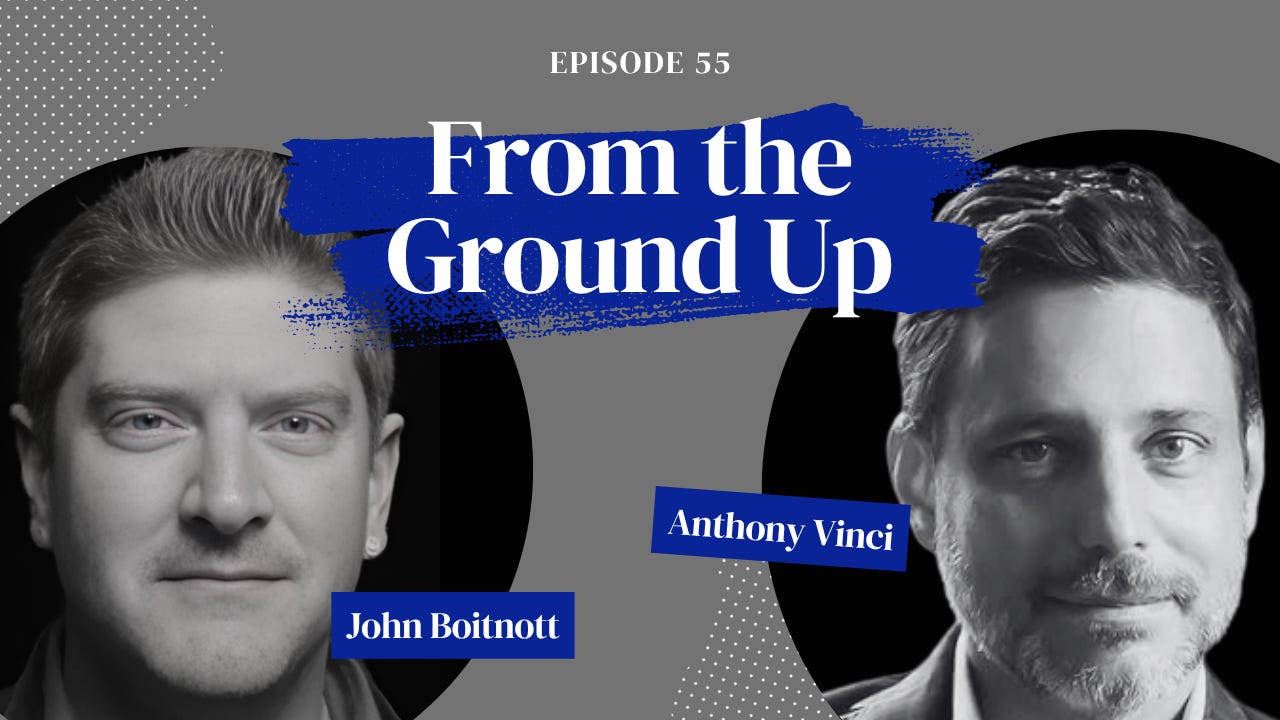
Anthony Vinci built VICO around a problem that keeps getting harder to ignore. The world is moving faster than the old decision-making systems can handle.
For Vinci, that realization came from a career spent around intelligence, technology, finance, and risk. He served as an intelligence officer, worked in Iraq, wrote The Fourth Intelligence Revolution: The Future of Espionage and the Battle to Save America, founded and exited a technology startup, invested at Bridgewater Associates, and later served as a managing director at Cerberus Capital. It is an unusually precise background for someone now trying to build a system that forecasts global events.
For more of my work, subscribe at 20% off below, and check out my Medium too.
Get 20% off forever
VICO, at its core, is a decision-making company. The platform uses artificial intelligence, mathematics, and data science to estimate the probability of future events. It is not simply an LLM wrapped in a forecasting interface. Vinci is clear that large language models alone are not reliable enough for this kind of work. They hallucinate, struggle with quantification, and are often too inconsistent for high-stakes prediction. VICO’s system combines AI with validation layers, orchestrated processes, Bayesian reasoning, time-series analysis, and other mathematical tools designed to make forecasting more structured and repeatable.
The inspiration is partly practical and partly literary. Vinci points to Isaac Asimov’s Foundation and its concept of psychohistory, the fictional science of predicting the behavior of large populations. VICO is not claiming science fiction has become reality, but the ambition is similar enough to be telling. Vinci wants to make the future less opaque for people who have to make serious decisions before the full picture is available.
That need has become more urgent. The pandemic, wars, elections, AI acceleration, space commercialization, supply-chain disruptions, and geopolitical instability have all compressed the time leaders have to react. The old model of spending weeks researching an issue, writing a memo, and handing it to a CEO no longer fits the pace of the world. By the time that process ends, the facts may have changed.
Vinci’s answer is not to promise perfect prediction. In fact, he argues that forecasting is often misunderstood. The real value is not only knowing what will happen. It is running scenarios, assigning probabilities, and thinking through possible responses before the event arrives.
That shift matters because most leaders still think about world events in binary terms. There will be a war or there will not. A ceasefire will happen or it will not. A restriction will be imposed or it will not. Vinci sees more value in treating risk as a spectrum. A 20 percent probability and a 35 percent probability may both sit below certainty, but they lead to very different decisions. For a hedge fund, that difference could change a trade. For a company, it could determine how much attention, budget, or staffing should be assigned to a risk.
This is where VICO separates itself from public prediction markets such as Polymarket or Kalshi. Vinci sees those platforms as useful in familiarizing the public with probability-based thinking. They have made more people comfortable with the idea that future events can be priced as likelihoods. But he views VICO as fundamentally different. Prediction markets depend on betting pools. VICO uses AI and mathematics to forecast questions directly, which means it is not limited to events that already have a market.
That distinction becomes more important when the question involves strategy, geopolitics, or individual decision-making by world leaders. Prediction markets can be strong when they resemble elections, where a large group of participants acts almost like a sample set. They become less reliable, in Vinci’s view, when they simply track news cycles or crowd sentiment rather than model what could happen next.
His thinking is heavily influenced by the work of Philip Tetlock and the research behind “superforecasters.” Vinci was struck by the idea that forecasting could be broken into a process: establish a baseline, decompose the question, run scenarios, update probabilities, and repeat. The most revealing part of that research was that disciplined forecasters using public information could outperform intelligence analysts, even when those analysts had classified material. For Vinci, that proved forecasting could be systematized.
The stakes are highest in fields where a small improvement in decision-making matters. VICO currently serves areas like finance, national security, and policymaking, where a single decision can involve millions of dollars, life-or-death consequences, or regulations affecting millions of people. A one or two percent improvement may sound small in the abstract. Applied to a billion-dollar position or a major national policy, it becomes enormous.
VICO’s integration into Bloomberg terminals marked an important milestone for the company. It signaled that the financial market was taking event risk seriously and that Vinci’s core thesis had commercial weight. Global events are no longer background noise for investors. They are tradable, hedgeable, and increasingly central to how capital moves.
But Vinci’s view of risk extends well beyond Wall Street. One of the global issues he believes remains underpriced is supply-chain exposure to China. Even if a business leader believes there is only a modest probability of a China-Taiwan conflict in the next few years, the consequences could be severe enough to merit planning. A disruption or economic decoupling between the United States and China would represent one of the largest economic shocks in modern history.
His advice is less dramatic than the scenario. Build resilience before the crisis. Spend time identifying alternate suppliers. Move a portion of production away from a single point of dependency. Be cautious about relying on foreign AI models or software infrastructure that could carry security or access risks. In Vinci’s framework, risk planning is not paranoia. It is the discipline of refusing to be surprised by problems that were already visible.
That discipline also comes from his intelligence background. Vinci notes that people often misunderstand what intelligence professionals actually do. Forecasting is only one piece of the work. Much of intelligence is explaining what happened, what is happening now, what may happen next, and what should be done about it. VICO began with forecasting because it is measurable, but Vinci’s larger aim is to support the entire decision life cycle.
That approach is also shaping how he runs the company internally. The rapid development of AI has changed what it means to build a software business. Vinci says the old startup operating model, with conventional agile rituals and predictable engineering cycles, does not fully match the current moment. AI agents are becoming part of the team, and the strongest employees are those who can operate like builders, directing multiple tools, experimenting quickly, and adapting as capabilities change.
The challenge is that the ground keeps moving. Every few months, new models expand what is possible, forcing companies like VICO to reassess product architecture, workflows, and even the customer experience. Vinci sees that instability as difficult but energizing. For an entrepreneur, it is the kind of problem worth having.
His broader message to founders is simple enough to overlook. Lift your head up. Entrepreneurs spend so much time inside the daily grind that they can begin seeing the business through a narrow straw. Forecasting starts with breaking that pattern, even briefly. Five minutes of scenario thinking can shift how a leader sees the company, its risks, and its opportunities.
Vinci is not arguing that every business owner should become an intelligence analyst. He is arguing that every serious decision-maker now has to think a little more like one. The world is too fast, too connected, and too exposed to cascading events for leaders to rely only on instinct or yesterday’s information.
VICO is Vinci’s attempt to build the missing layer between information and action. In a world where risk no longer waits for the next quarterly planning cycle, he is betting that the future belongs to leaders who can think in probabilities before everyone else is forced to react.
Want more From the Ground Up? Check out more articles or head over to YouTube, Apple, or Spotify to watch the videos.
I am a journalist and digital consultant who has worked at media companies for 25 years and advised startups since 2007. I write about emerging companies, marketing and leadership at Entrepreneur, Jotform.com, CEOfficialmag.com, Under30CEO, and my blog.